07 април 2026
Why South-East Europe Matters More Than Ever: How the Iran War Reshapes Textile Supply Chains
The current Iran-centered war is not just an energy story or a geopolitics story. For textile buyers, importers, and sourcing teams, it is a supply-chain story with real consequences: longer transit times, higher freight costs, pricier synthetic inputs, and more pressure on planning. For bedding categories in particular (including pillows, duvets, toppers, and other bedding products), the disruption matters because these products depend heavily on reliable logistics and, in many cases, oil-linked materials such as polyester fibers and nonwovens.
That is why this conflict is especially relevant for companies that still rely heavily on long-distance sourcing routes through Asia-to-Europe maritime corridors. Even before the current escalation around Iran, global trade had already been under strain from the Red Sea crisis. UNCTAD reported that Suez Canal transits were down 42% from peak levels by January 2024, while the broader disruption in the Red Sea and other chokepoints was already reshaping maritime trade patterns. The World Bank later found that supplier delivery times had notably worsened in Europe since the start of the Red Sea crisis.
Why this war hits the textile industry so directly
Textiles are unusually exposed to geopolitical disruption because the sector is squeezed from both ends. On one side, many raw materials and production inputs are globally traded. On the other, finished goods are often bulky, margin-sensitive, and timing-critical. Bedding products are a good example. A pillow, duvet, or topper is not a microchip: it takes up space, freight matters, packaging matters, and delays quickly affect stock availability, warehouse planning, promotions, and retailer commitments. That makes any jump in transport cost or transit time a bigger commercial issue than it might be for smaller or higher-margin goods. This is an inference based on the documented freight and routing pressures and the physical characteristics of bedding products.
The Iran war has intensified that pressure through energy and shipping. According to the IEA, after the U.S. and Israel launched joint air strikes on Iran on 28 February 2026, disruptions to Middle Eastern supply and halted tanker traffic through the Strait of Hormuz pushed Brent close to $120 per barrel before easing to around $92 per barrel later in March. That matters for textiles because conventional polyester is made from fossil-fuel-based chemicals whose primary raw material is crude oil. In practical terms, when oil becomes more volatile, polyester-linked textile inputs become more exposed as well.
For bedding manufacturers, that exposure is hard to ignore. Polyester filling, microfiber shells, synthetic batting, nonwoven components, packaging films, and many petrochemical-derived materials used across pillows, duvets, and mattress-related products can all feel the knock-on effects of oil and shipping volatility. Even when the final price effect does not appear immediately, uncertainty pushes suppliers to shorten quote validity, add buffers, or renegotiate terms. That is often where buyers feel the first commercial shock. The raw-material linkage itself is directly documented; the supplier behavior described here is a market inference consistent with the broader disruption.
The logistics shock is just as serious as the raw-material shock
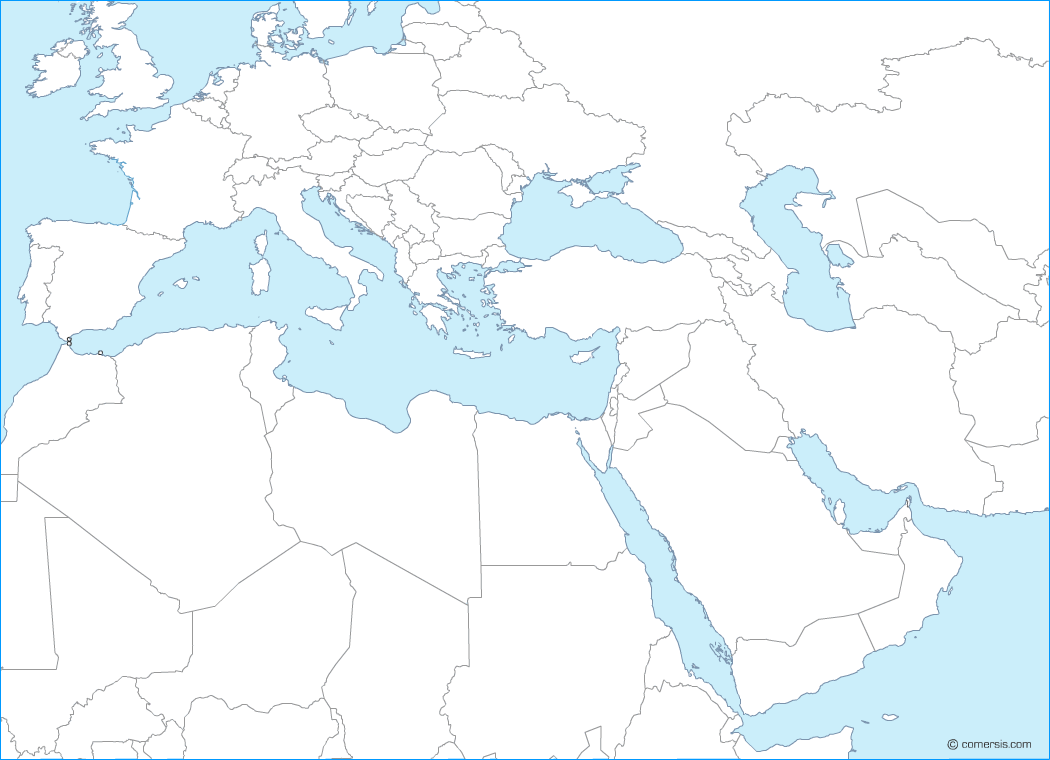
The shipping side is now just as important as the materials side. Reuters reported that major container carriers including Maersk, Hapag-Lloyd, and CMA CGM have been rerouting vessels around the Cape of Good Hope, with diversions adding 10 to 14 days of transit time. The same report noted war-risk, emergency conflict, and deviation surcharges of $1,500 to $3,300 per standard container, rising as high as $4,000 for specialized equipment.
For textile companies, those numbers are not abstract. A 10- to 14-day delay can throw off replenishment cycles, seasonal launches, and retail delivery windows. A multi-thousand-dollar surcharge per container can materially change landed cost, especially for categories where cube utilization and freight density already matter. Bulky home-textile and bedding products are particularly exposed because transport cost per unit can move faster than many buyers expect. The specific delay and surcharge figures are sourced; the category exposure is a practical inference from those cost mechanics.
There is also a wider cost-to-serve effect. Transport & Environment estimated that the latest Gulf conflict is costing shipping companies an extra €340 million per day in fuel, with very low sulphur fuel oil in Singapore up 223% since the start of 2026 and LNG prices up 72% since early March. Even if not all of that gets passed on line by line to textile buyers, it raises the baseline pressure across ocean freight, feeder services, scheduling, and contract negotiations.
Why Europe-based and regional sourcing is becoming more strategic
This is where South-East Europe becomes more than a geography. It becomes a risk-management strategy.
North Macedonia sits between Corridor 10, the major north-south route, and Corridor 8, the east-west route, and the country’s development strategy explicitly describes it as being at the crossroads of South-East Europe. At the same time, North Macedonia’s textile and garment sector is strongly export-oriented toward EU markets, and Invest North Macedonia states that 93% of garment production is organized for foreign markets, with Germany as the dominant destination. World Bank WITS data also shows Germany, the Netherlands, Austria, Greece, and Bulgaria among the top destinations for North Macedonia’s textiles and clothing exports.
That matters because a sourcing model built closer to the end market is less exposed to the exact maritime chokepoints now under stress. It does not remove every risk, but it can reduce dependence on long ocean routes, improve communication, simplify factory visits, and make order adjustments easier. That is an inference from the region’s location and export structure, but it is precisely the kind of resilience many buyers are now looking for.
North Macedonia’s broader trade profile also shows why it is relevant in this discussion. The country exported about €8.0 billion in goods in 2025, up 2.9% year over year, and EU member states accounted for 58.9% of its total trade. In other words, this is not a theoretical production location disconnected from Europe. It is already integrated into European trade flows.

What this means specifically for bedding products
For companies buying pillows, duvets, toppers, or related filled products, the current environment changes what “good sourcing” looks like.
Price still matters, but price alone is no longer enough. Buyers now need to ask different questions:
- How exposed is this supplier to imported synthetic fibers?
- How quickly can they adapt fillings or fabrics if input prices move?
- How reliable is their access to packaging?
- Can they produce smaller repeat orders instead of forcing large, risky inventory bets?
- Can they reach EU customers without depending on the most disrupted sea lanes?
These are not separate operational questions anymore. They are now strategic sourcing questions shaped by war-driven volatility. The shift in criteria is an inference grounded in the disruptions documented above.
How Immoricon can help
This is exactly where Immoricon’s position in South-East Europe becomes valuable.
Because Immoricon operates in the textile and bedding space and is based in a region that is tightly connected to European markets, it can help buyers reduce some of the supply-chain fragility that has become more visible during the Iran war. In practical terms, that means helping brands and importers identify bedding-focused manufacturers in a nearer-shoring geography, compare supplier options with a stronger focus on resilience, and build sourcing setups that are less dependent on long and vulnerable intercontinental freight routes. This is a strategic inference based on Immoricon’s sector focus and the region’s trade position.
For buyers of pillows, duvets, and toppers, the benefit is not only geographic proximity. It is also operational control. A regional sourcing partner can help with factory screening, communication, quality alignment, sampling, follow-up, and contingency planning when markets become unstable. In an environment where freight surcharges can jump by thousands of dollars per container and delivery windows can move by two weeks or more, that operational control becomes commercially meaningful.
Get in touch with us today
Related News

14 септември 2026
How to Prepare for the Autumn Season in the Bedding Industry
Autumn is one of the most important transition periods for the bedding industry. For retailers, wholesalers and bedding brands, however, autumn starts much earlier than the first cold night. At Immoricon, we work closely with manufacturers and buyers across the bedding and textile supply chain. One thing experience teaches quickly is that seasonal sourcing works best when businesses prepare for demand rather than react to it.
Read More...
10 јуни 2026
How to Choose the Best Products from the Sleeping Industry: Pillows, Mattresses, Bedding and Duvets
Consumers today are no longer buying a pillow or duvet simply because they need one. They are looking for better sleep, healthier materials, sustainability credentials, and products that fit their lifestyle. Choosing the right sleeping products does not revolve aboud price only. It is about understanding your market, selecting the right materials, and building a product portfolio that customers trust.
Read More...